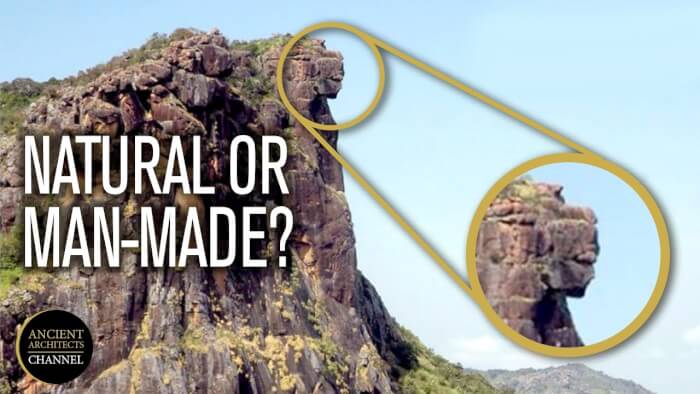
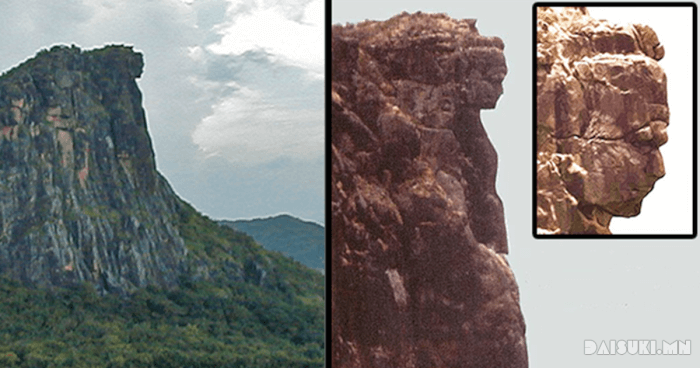
The Lady of Mali, also known as the White Lady of Africa, is a giant woman p sculpted on Mount Loura, north of Guinea Conakry, near the borders of Senegal and Mali, two countries in Western Africa.
It was first found in 1997 by Italian geologist Angelo Pitoni during his search for diamond deposits.
Since then, scientists haven’t been able to identify if the statue had been formed from erosion or if it was truly a man-made masterpiece. And the former possibility is gradually ruled out because the region has few winds and few abrasive particles able to mold the granite cliff.
Another unusual feature is that the face of this massive statue is a Caucasian one, far from similar to African facial featues.
Initially, scientists predicted that the statue dates back 5,000 years, however, latest examination revealed that the surface sediments could have been 25,000 years old, remaining a discomfort for scientists.
These stone’s material is artificial, meaning that they must have been synthesized in a mysterious way millennia ago, according to the Institute of Natural Sciences in Geneva.
Pitoni was only able to come up with the clarification he believed to be the most feasible: the image of the goddess had to bear some resemblance to the ones in the mythology related to the ancient civilization of Atlantis.
Pitoni then concluded that the civilization’s survivors, though only a few, had been able to take refuge in West Africa.
The White Lady of Africa would not be of this age, but would belong to a previous civilization, when this planet was inhabited by other types of beings.
The question remains: Why was such an important discovery not given any importance?
 Source: Pinterest
It was first found in 1997 by Italian geologist Angelo Pitoni during his search for diamond deposits.
Since then, scientists haven’t been able to identify if the statue had been formed from erosion or if it was truly a man-made masterpiece. And the former possibility is gradually ruled out because the region has few winds and few abrasive particles able to mold the granite cliff.
Another unusual feature is that the face of this massive statue is a Caucasian one, far from similar to African facial featues.
Initially, scientists predicted that the statue dates back 5,000 years, however, latest examination revealed that the surface sediments could have been 25,000 years old, remaining a discomfort for scientists.
 Source: Pinterest
These stone’s material is artificial, meaning that they must have been synthesized in a mysterious way millennia ago, according to the Institute of Natural Sciences in Geneva.
Pitoni was only able to come up with the clarification he believed to be the most feasible: the image of the goddess had to bear some resemblance to the ones in the mythology related to the ancient civilization of Atlantis.
Pitoni then concluded that the civilization’s survivors, though only a few, had been able to take refuge in West Africa.
The White Lady of Africa would not be of this age, but would belong to a previous civilization, when this planet was inhabited by other types of beings.
The question remains: Why was such an important discovery not given any importance?